
NOLAN’S STORYLINE
Posted July 17th, 2026 at 7:39 amNo Comments Yet
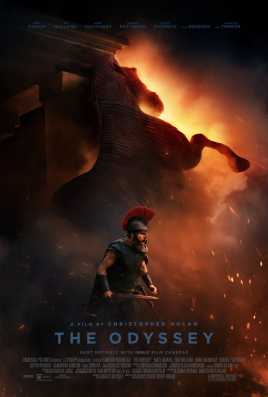
HOMER’S EPIC POEM GIVEN EPIC SWEEP BY A MASTER
by PETER THOMAS BUSCH
Greek mythology meshes with real time war, history with song, and poem with film.
A lot of the bones of this story survived orally, until humanity mastered writing, and storytelling through song gave way to written poems.
The Odyssey may have been the first written epic poem.
Now images on film tell the stories, and director Christopher Nolan helps modern civilization remember the heroic tales of the past with the truth, the lies and the fantasy of the present and near future.
In Odyssey (2025) Nolan takes the epic Greek poem by Homer and attempts to do justice to the truth of the tales – while not only honouring Zues and Poseidon, but ancient Greek and present day humanity.
Odysseus, played by Matt Damon, has conquered Troy but he has lost the ability to return to his Kingdom of Ithaka. In the real world, Ithaka is a rugged island within the Greek empire, and Troy is within the Ottoman Empire, found in an archeological dig on the coast of modern day Turkey.
Homer makes the difficult decision to leave his kingdom, wife and young son for what is certain to be a long drawn out war under the command of Agamemnon. Historicists suggest that the Trojan War occurring around 1200 BC only took a few weeks, whereas Homer describes a ten year war.
Now ten year wars were not uncommon in the sword and sandal era of warfare, with the Crusades taking many years, and the Anglo-French war dragging on for over one hundred years in 1200 AD.
Nolan uses a 2 h 52 m runtime to tell the story of all stories, perhaps the founding story of present day humanity inherited from Ancient Greece.
The ensemble cast assembled around Odysseus includes Antinous, played by Robert Pattinson, Polubus, played by Corey Hawkins, the son of Odysseus, Telemachus, played by Tom Holland, and the wife of Odysseus, Penelope, played by Anne Hathaway.
The sweeping epic film begins with the telling by the Bard, played by Travis Scott, as Nolan tips the camera to the oral tradition of singing the epic poem as opposed to reading the stories of the Trojan War. And Nolan’s newest trick is making the narrative float like the words and rhythm of a song.
Zendaya has recurring scenes as Athena, the daughter of Zeus, as the story revisits characters and themes like a song will repeat in a predictable rhythm. Athena appears only momentarily to give Odysseus guidance so as to prevent him from becoming eternally lost.
And Charlize Theron plays Calypso who has tricked Odysseus into remaining with her for 7 years, as part of Odysseus’ 10 year journey home to Ithaka. The long journey home is explained in part by Calypso finding Odysseus adrift in the sea and subsequently nursing him back to health.
The narrative involves several stories told by the characters that merge together as if part of the protagonists’ streaming contributions to the collective consciousness. Damon, for example, is tasked with telling the stories of being recruited to join the Trojan War, and then the story of the sack of Troy and subsequent return home.
Nolan has Odysseus telling these stories in the past tense to Calypso as Odysseus begins to regain his memory and understand that he had been on a journey home to his wife and son, before disaster struck his ship.
The other three years journey home involves difficulties with the tides and the wind on a ship that depends on wind in the sail for propulsion, as well as the need to obtain provisions, such as food and water for the next sea leg in the journey home.
The ship is an open sailing ship without the galley typically found in seaworthy sailing ships designed for much longer travels two millennia later.
Each trip ashore for food and water becomes a reiteration of humanity’s greatest struggles to have competing societies live in peace and harmony.
In Homer’s telling, under the eye of the Greek God’s, reservations toward strangers in different societies becomes a clash of wills between humanity and monsters.
Damon shows how Oddysseus’ difficulty in getting home may be in the form of punishment by the God’s for sacrificing his family and many lives for the cause of a distant war. Elliot Page plays one of the many haunting ghosts, Sinon.
Ludwig Goransson composes a score for the film. And Nolan uses the score to drive every scene, similarly to the use of a score in the Batman Trilogy (2005-2008-2012) scored by Hans Zimmer, and Oppenheimer (2023) also scored by Goransson, with a dark pounding score communicating as much, if not more, at times than the actors and actions being portrayed on screen.
Damon undertakes a physical transformation, simultaneously losing body fat while gaining muscle mass for several scenes as one of the greatest sword and sandal warriors. Damon also has a bit of an acting renaissance, obviously being pushed by Nolan’s magic film formula to provide more, and at times, uncommon acting art for the movie Gods. Even the actors in reserve seem to be compelled to produce a scene stealing splash of acting, such as John Leguiamo as Eumaeus, the blind loyalist in the Ithaka court, and Jon Berthal as Menelaus, and Lupita Nyong’o as the twin sisters Helen and Clytemnestra.
Hathaway, who also played Selina in Nolan’s Batman, The Dark Knight Rises (2012) and Brand in Nolan’s Interstellar (2014), flourishes in The Odyssey as Penelope, occasionally dropping an intertextual acting reference to Selina and Brand.
The loyalty of Ithaka’s Queen, still waiting for the return of her King after 20 years, is juxtaposed with an increasing exasperation just as the suitors become impatient and Odysseus gets that much closer to home.
Hathaway and Holland play off each other in several scenes. Holland portrays the son of Odysseus and Penelope as a bit fearful of the group of 108 drunken suitors eating in his father’s banquet hall every night, while also becoming emboldened to end the drama and become King as heir apparent.
Homer was the greatest of Greek poets whose songs were repeated for centuries in every Greek household as part of the historical cultural record of the ancient civilization. Nolan does service to Homer and the Greeks by creating a cinematic masterpiece that will undoubtable dominate the summer box office and benefit from a number of reiterations going forward into the near future.