AGNES
TRAUMA HOLDS HUMANITY IN SURREAL MOMENTS OF MORAL CONFUSSION
by PETER THOMAS BUSCH
Reality may be thought provoking enough without imposing a layer of drama over recuring universal truths.
Director Agnieszka Holland uses realism to bring to the surface of the story themes embedded in the long days when the desperate need to survive becomes the primary focus.
This cinematic emotive effect interlinks historical events with the victims as well as with the heroic and villainous personalities of humanity who never seem to be in short supply.
Holland discloses through her investigations that no one is immune from taking morally wrong actions. People struggle to exits and will make choices they would not otherwise make to survive that struggle.
In Green Border (2023) Holland tells the story of a group of illegal migrants from Syria as they jump the Polish border with Belarus. The passage to a better life though provides as much commentary on the Polish people as the refugees when each side must make difficult choices.
Deciding is only the first challenge as the narrative then depicts characters struggling with their choices, including the difficulty in knowing who among the strangers to trust and of whom to be fearful.
Holland also explores the limits of individual identity conditioned by state policy. People are forced to engage with the issue although left with the dilemma of having to choose without knowing beforehand what the moral consequences look like in a particular context.
Characters choose correctly by helping the migrants. Other characters choose correctly by not helping the migrants. This divisive issue is explained without the director choosing right or wrong outcomes. Instead of being didactic, the director casts all involved as part of a broader dilemma that can envelop the human condition.
This moral confusion leads to an existential crisis that lingers over several films as a specter of surrealism.
In The Darkness (2011) the consequences of the moral confusion that occurs during traumatic historical events becomes personified by a group of Jews fleeing the Holocaust.
Few heroes exist in such a crisis of choice when sewer worker Leopold Socha helps a group of Jews escape certain death by hiding them in the city’s sewer system. History gives up few good choices for the persecuted during a Holocaust.
Socha initially demands a fee for helping the Jews. Holland shows how the ability to hide from certain death is more important than the moral cost of choosing a lesser evil in overwhelmingly dire circumstances.
Holland uses the storyline to show how people adapt to the worst of conditions, and then how the horrible context can still get much worse, when the spring rains begin to fill the sewers with water runoff.
Holland also explores the choices humanity makes when survivors become morally compromised in Angry Harvest (1985).
Rosa flees from a train that is destined for a concentration camp where she will surely be killed as part of the Holocaust. In the frantic race to safety through the forest Rose becomes separated from her husband and son.
Leon, an elderly bachelor living nearby, finds Rose suffering in the forest and makes a hiding place in his house where she can recover. Leon’s good intentions come into conflict with Rosa’s singular purpose to survive when he reaches out to her for comfort as a lonely, isolated elderly farmer.
All the good intentions incrementally become compromised by the primary human impulse to seek out companionship as just one part of a complicated decision-making process. Holland creates protagonists who are ultimately on a journey of survival, filtering a myriad of needs and wants and desires that continually challenge individual identity.
Holland also underscores that human frailties are often brought to the surface by state action. Social policy provides a sense of purpose that, in a crisis, can tare people apart from the inside out.
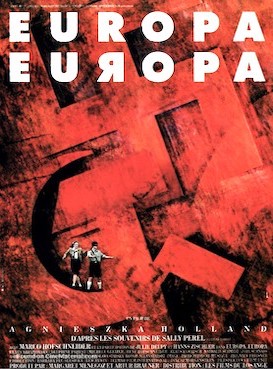
The unimaginable tyranny of the individual that occurs during war is captured in Europa Europa (1990).
Holland follows a boy’s escape from Germany and the need for him to betray his Jewish identity in order to survive.
The camera captures the moral confusion Solomon Perel encounters when forced to make difficult choices, such as joining the Hitler Youth. The narrative follows the power of the state continually absorbing individual identity and forcing Solomon to again betray his identiy in different ways.
And, the cause and effect of famine can determine the moral choices people make for different reasons.
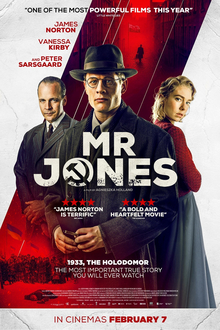
In Mr. Jones (2019) Holland captures the individual purpose of young Welsh journalist Gareth Jones who becomes famed for having interviewed German Nazi leader Adolf Hitler, after Hitler was appointed Chancellor in 1933.
Jones calls in favours to obtain a temporary visa for travel to Moscow where he intends to Interview Soviet leader Joseph Stalin. But Jones’ meeting with Hitler is so remarkable that he struggles to obtain accreditation as a journalist after being discharge from his employment as advisor to British MP and former Prime Minister David Lloyd George.
The storyline sends the protagonist traveling into the history of a man-made famine in the Soviet controlled Ukraine.
Mr. Jones is a more aesthetic film involving multiple themes swirling about with journalist George Orwell in the far background to provide commentary. Holland contrasts this metropolitan dynamic in London and Moscow with the emptiness of an agrarian area stricken with famine, and the horrible choices people have to make to survive.
Colors disappear from the canopy as Jones discovers death in the streets and death everywhere else, and children making the worst of bad choices to avoid starvation.
The presence of tyranny may be reason enough to rebel. Still others support the idea and find bad choices in other places.
No nation is safe from tyranny with the Nazis control of the Czech Republic having been ceded to the Soviets. The nation is controlled by communist ideologs and autocrats during the fifties.
In Charlatan (2020) healer Jan Mikolasek uses plant-based remedies and intuition to save many lives.
The state authority does not approve though and decidedly persecute Mikolasek until finally convicting him for the death of two officers.
Holland accepts that the disenfranchisement of individuals occurs just as she does state sponsored violence. The state merely catabolizes the physically brutal and morally confusing world into smaller, indecipherable bits.
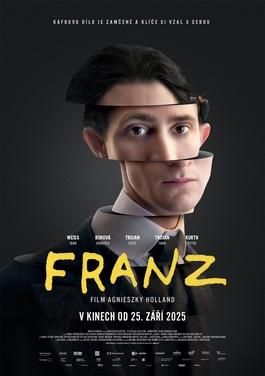
In the film Franz (2025), Holland uses an aesthetic to simulate the thought processes of a genuinely authentic individual thinker.
Czech writer Franz Kafka struggles to define himself from within the obscure life shaped by a fierce patriarch insisting on maintaining control.
The director’s lens finds Kafka, as a young adult, balancing expectations with the need to find an independent definition of self as part of a broader purpose in life he himself can choose.
Holland continues on a journey in creativity since life has become a struggle to find purpose away from the conventional thinking imposed by the state and the patriarchal family structure that continues to control destinies.
Kafka ends his story just as he began with true stories too remarkable to be believed.
Holland relies on the recuring nature of universal truths as narrative devices, and then builds the story around them by drawing from historically true events and the victims, heroes and guilty parties.
Catholicism and Judaism in the same social context can be pulled into conflict with each other by less benevolent state players as the politicians may purposefully divide the populations along political loyalties.
People, nevertheless, are similar in that a fragile moral fabric may crumble when the desire to survive distills all the choices down to only the one real choice that matters the most.