
de GAULLE
Posted November 14th, 2026 at 12:27 amNo Comments Yet
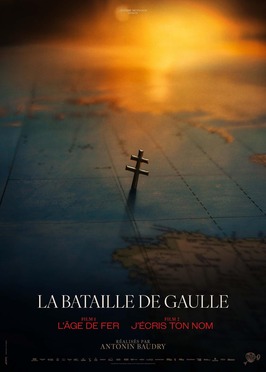
FRENCH CINEMA FIGHTS FOR NATIONAL ICON
by PETER THOMAS BUSCH
Only the French have enough confidence to make fun of their own national hero.
Director Antonin Baudry pokes fun at the imaginary army that the iconic General Charles De Gaule created for British Prime Minister Winston Churchill in the French biopic La Bataille de Gaulle (2026).
The Germans have captured Paris after the French Government capitulated to save the city from destruction on June 22, 1940. Not everyone was happy with the armistice, though.
De Gaulle escapes to London to court the British into an alliance against the Germans, but he has little success initially because he is a relative unknown even among the French. British Prime Minister Winston Churchill considers de Gaulle a distraction in the bid to have the Americans enter the war.
Simon Abkarian plays de Gaulle as a determined fighter who is willing to enter a great struggle to free France from German occupation.
The film, which has been split into two films, Part 1, Resistance, with a 2h 40m runtime, uses three narratives, one in the far background of the world war raging against the German military, narrative two of de Gaulle developing a Free France resistance movement from an office in London, and a third narrative with a teenage resistance fighter in Paris trying to organize the population against the capitulating French Government and the Germans.
Part 2, Liberte, has a runtime of 2h 37m.
Unlike certain Military Generals who might still be commanding a platoon of soldiers, de Gaulle has no one in London other than his personal aide who voluntarily leaves Paris to be by his side.
Baudry pokes fun at how few supporters de Gaulle has from the French population, such as not knowing where on a map of the world the first French territory that aligns itself with the Free France Resistance is located.
Volunteers living in London as part of the French diplomatic corps do come forward, as well as military evacuees from the beaches of Normandy and Dunkirk, who escaped as the Germans advanced. De Gaulle has so few to choose from, the first ten people through his office door become cabinet members for the Free France Resistance.
De Gaulle takes a bit out of King Charlemagne’s play book in the way he creates an army. An imaginary battalion of soldiers advances on the French African colony, Chad, to impress the Americans and open a port for their naval ships.
And a small desert battalion of 1000 soldiers holds back the Germans at Bir Hakeim.
Cinematographers Giora Bejach and Pierre Cottereau are put to work with making every scene different and also aesthetically pleasing.
And composer Volker Bertelmann creates a score that oscillates with the action on film, in Part 1, Resistance, while not overpowering the intense dialogue, such as that between de Gaulle and Churchill. Theo Cascio composes the score for Part 2, Liberte.
Returning to the continent of France is too obviously hopeless. So, de Gaulle pitches the idea of persuading the French African colonies to pledge allegiance to the Free France resistance.
The script gets serious enough, with the sensory aesthetic eventually creating an uncontrolled response with each subsequent success. The director plays the long game in this regard, over five hours of films.
Archival news reels are used to put together the narrative in the background, while a montage accelerates the German occupation in movie time. In Part 2, archival footage creates poignant moments, as de Gaulle’s plans have come to fruition and Paris is liberated.
The resistance is just taking shape in Part 1, but by Part 2 the unhappy French get organized, and the British help arm them with rifles. Anamaria Vartolomei plays Livia, the radio operator for the resistance.
Florian Lesieur plays the young resistance fighter, Fernand, who is the only one who shows up at his first organized meeting under the Arc.
De Gaulle uses BBC Radio in London to message the resistance movement in Paris. Livia relays the messages to the leaders who eventually form a council that includes members of the French parliament.
The overall vision of the film personifies de Gaulle as the resistance movement and the French mentality of being the best of everything, and subservient to no other nation state.
Simon Russell Beale plays Winston Churchill. The performance seems like a caricature at first but then the image becomes a bit more endearing, as the little idiosyncrasies emerge, such as drinking scotch, smoking cigars and taking baths.
Churchill is shown to strike-up a relationship with de Gaulle in public, but he also takes some mean spirited swipes at him in private, quickly turning on him to keep the favour of the Americans.
Beale shows Churchill to be focused on saving England, even at the expense of his relationship with France. The Churchill character is difficult to do, having been done by other actors so many times before. But Beale creates a performance, over five hours, that can be distinguished from previous portrayals of Churchill.
Similarly, Baudry creates that epic sweep for the film, like that created by David Lean for Laurence of Arabia (1962) and Doctor Zhivago (1965).
De Gaulle is decidedly French, though.
Niels Schneider as General Philippe Leclerc has a more substantial role in Part 2 as the African campaign gets underway and the French are positioned to prevent the German advance. Leclerc is one of de Gaulle’s early recruits from those who come forward in London, and he earns his hero medal in part by remaining loyal to de Gaulle throughout the war.
De Gaulle has his rivals from within France as well. From the outset, the French Government of occupied France convict de Gaulle of treason. And the Allies do not really like de Gaulle as their first choice to lead France.
The film, in part, explains the outcome, as well as the iconic leadership behind Free France.