SARAH
LIFE HOLDS FEW AUTONOMOUS MOMENTS
by PETER THOMAS BUSCH
Life in the present is not so easy.
The past keeps creeping up on the present often to determine outcomes as brutal as getting hit over the head with a fire extinguisher.
Director Sarah Polley puts on film the struggle of the individual for self control over one’s own mind and body.
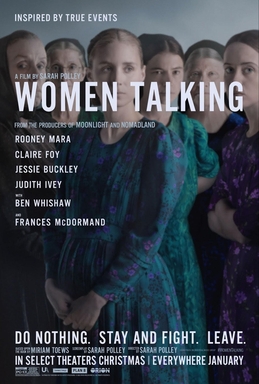
In Women Talking (2022) Polley paints the portrait of a Mennonite Colony whose women have discovered that they are under attack at night while sleeping.
The women and girls gather in the hayloft to discuss that what has been occurring to them has not been a spirit visiting them during the night, as they had previously been gaslit into believing.
The mind and body are vulnerable, compelling forces, but the conversations are influenced as much by their faith as the need for peace of mind and physical security.
Polley uses a black lit set with light seeping into the hayloft in between the loosely fitted planks of a barn. The set is presented as a metaphor for the mind trying to sort out the reason from the chaos caused by a traumatic event.
Creative camera work turns several scenes into rural portraits.
The ensemble cast of women, who include Rooney Mara, Claire Foy, Jessie Buckley, and Frances McDormand, share their own unique perspectives that are woven together with common values, such as the rule structure developed for the colony and a devout faith in God that constantly guides them.
Polley occasionally shifts the tone from the serious undertaking in the main narrative of deciding what to do, such as doing nothing, staying with the colony or leaving the colony, to intermittent lighter moments. The characters spontaneously gain emotional relief from the shared trauma through the use of dark humour.
This psychological release storms into the darkened surroundings of the hayloft until a door opens.
The script resonates with several of Polley’s themes that recur throughout her film work.
In Alias Grace (Series 2017) Polley writes from the perspective of a commoner who makes her way into more secure circumstances by working as a servant girl to the wealthy estate owners.
The screenplay for the miniseries is based on the 1995 Margaret Atwood novel of the same name. Atwood based the story on the true 1843 murders of employer, Thomas Kinnear, and his head housekeeper, Nancy Montgomery.
The narrative shifts from establishing the vulnerability of a young woman, within a patriarchal society, to the gender-based limitation in society that quickly become reinforced by the social barriers of class and one’s station in life.
Sarah Gadon plays Grace.
In one narrative, Grace, is being interviewed by a criminal pathologist, after Grace has been accused of murdering her employer and the head housekeeper in a desperate bid to escape a life of servitude in the colonies.
A second narrative about Grace’s day-to-day life as a servant girl is given voice as she explains herself to the doctor.
The doctor, played by Edward Holcroft, has difficulty not becoming smitten with Grace. Paul Gross plays the employer, while Anna Paquin plays the head housekeeper.
The recurring theme of the uncontrollable mind is underscored when Grace cannot remember the murders, while otherwise presenting as a beautiful woman with a proper upbringing.
Polley uses a stream of thoughts as a narrative device, constantly changing the time of the narratives from the present to the past as Grace answers the doctor’s questions.
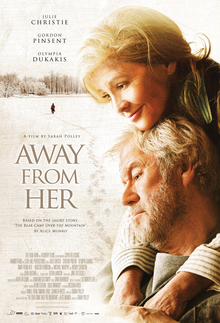
In Away from Her (2006) Polley writes and directs the linear narrative about a married couple torn apart by a disease of the mind.
Fiona, played by Julie Christie, begins to lose her memory, but she recognizes the trouble well in advance, and as a result, chooses to move into a care home.
Grant, Fiona’s husband, played by Gordon Pinsent, does not want her to leave their happy home. But Fiona persists. Grant soon becomes heartbroken when he visits Fiona, because she no longer remembers him as her husband.
Fiona’s mind betrays her past life of love with Grant inside a happy marriage as she becomes infatuated by another resident of the care home.
The script explores the inability of humanity to predict the future, and how the mind and the body betray the spirit inside the individual. Polley shifts the camera away from a warm home with tea to a winter landscape as a way of illustrating the difficulties that will gradually come to visit people as they age.
Polley also explores how the mind betrays a person within her own family, in Stories We Tell (2012). The director explores the effects on the mind of the present tense becoming sidelined by the discovery of her birth father, after believing all along that her step-father was her real father.

Polley realizes, at the vulnerable age of 11, that the mind and body are far from invincible, when her mother dies of cancer. A disease can become all-consuming – and most of the time, there is nothing an individual can do about the outcome.
The documentary uses dramatized home movies on Super-8 film to illustrate the memory fragments, while family members from the two separate worlds share other secrets.
In Take This Waltz (2011) the director explores the possibility that few things within a person’s grasp can be entirely controlled.
Michelle Williams stars as Margot, a freelance journalist on assignment in the historic town of Louisburg, Nova Scotia. By happenstance, Margot meets Daniel, played by Luke Kirby.
Polley weaves the two characters closer together when, by coincidence, they are on the same plane bound for home.
Fate and/or movie magic have the travellers sharing a cab home from the airport only to find out that they are neighbours in the same Toronto suburb.
Polley shows the vulnerability of the mind by exploring the relationship between Margot and Daniel in the context of Margot being happily married for five years to Lou.
Lou, who is played by Seth Rogan, is a nice man, but he can be a bit uninspiring at times. This emotional gap in the marriage causes Margot to be interested in pursuing a relationship with Daniel.
Emotions becoming disentangled from one person and entangled with another person is used as the narrative device. Polley follows Margot and Lou until Margot’s heart begins to wander more purposefully toward Daniel. The narrative gradually leaves Lou behind entirely until there is no longer enough emotional attachment for Margot to remain at home.
People are again portrayed as having insufficient control over their own destinies. Something magical happens with the issues of the heart that leave people with no choice but to follow.
Polley, the director and screen writer, like Polley the daughter, decidedly controls the narrative by confronting difficult subject matter. Past trauma makes the present even more elusive – with confusing memories pulling people every which way, such as the false guilt in losing a mother, and the psychological trauma of not being able to overcome social stigma and gender-based economic barriers.
If the obvious pain of physical trauma is not enough of a deterrent, disease can occur randomly with tragic consequences. When that does not stop you, spontaneous events may still put you on the sidelines.
In this world, just dreaming to be free and to be in control of oneself can be problematic.