
PEASANT REVOLT OF 1381
Posted September 16th, 2026 at 7:19 pmNo Comments Yet
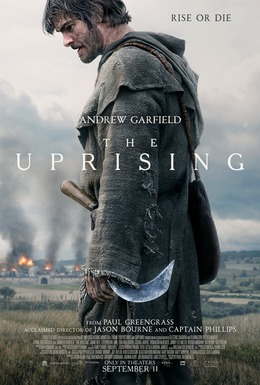
GARFIELD SHOWS RANGE IN TALE OF REVOLT AGAINST THE KING
by PETER THOMAS BUSCH
The child King Richard II had been cloistered from the kingdom, by a council of manipulative noble power merchants, as despair spread among the peasants.
Andrew Garfield plays the Ploughman who sparked a rebellion in the true to life historical drama of 1381, The Uprising (2026).
The plague had wiped out half the population of England while the survivors of the sickness struggled to continue on by working the land as peasant farmers haunted by their missing family members.
Director Paul Greengrass uses a handheld camera to imitate the frenzy inside and outside of the growing revolt of peasants wanting to petition the King for relief from the deprivation experienced working and living from the land.
Natural light is used to instill the emotive qualities of a period piece. CGI is used only sparingly, with the majority of scene sequences focused on the characters driving the growing rebellion marching toward London.
Garfield’s performance is compelling, showing a rollercoaster of emotive character development phases, from a concerned farmer still mourning the loss of his family to a violent rebellion leader setting the example for others to rise up against the King’s soldiers.
The camera initially finds the Ploughman working the fields, alone, exhausted and tending to three grave markers.
King Richard II has been convinced to raise taxes among the commoners, after England has emptied the coffers to pay for the wars against France and Scottland. The revolt begins because the peasants have nothing more to give for taxes and because of the horrible treatment of the young girls by the security detail accompanying the King’s tax collector.
Garfield portrays the Ploughman as patiently channeling his distress into fighting anger only when he has great cause to do so – which sets the example of similarly distraught and outraged neighbours.
A score plays lightly in the background.
James Bell and Cosma Jarvis play the face of the rebellion, as Garfield stays protected within the masses of tens of thousands of peasants quickly joining the march.
Woody Norman plays King Richard II. And Katherine Waterston plays the Mother of the Crown, who is somewhat sympathetic toward the peasants’ cause since she knows that her son, the King, is being manipulated by the court’s elders.
Norman gradually shifts from a vulnerable 14-year-old boy King to a more assertive King as the advice of the council, against his own intuitive knowledge, proves incorrect and actually serves to incite the crowd to march on the City of London.
Greengrass tries to honour the time and the gritty reality the peasants had to endure, with an emphasis on the characters of those farmers willing to sacrifice themselves by leading the Peasant Revolt.
Casting draws in a bit of an ensemble of actors, such as Stephen Dillane as Archbishop Sudbury, Tom Hollander as Treasurer Hales and Stanley Townsend as Chief Justice Bishop.
These characters provide transition scenes showing how the King is influenced into poor decisions in how to deal with the growing rebellion as news of the march reaches the King’s court.
Putting down the rebellion is not possible because the King’s armies are too far away, in Scottland and France, to head off the peasant march, even as several castles are sacked.
Greengrass is known for historical dramas of significant catastrophic events such as United 93 (2006) and The Lost Bus (2025), as well as films in the Bourne franchise.