
JOLIE NIGHTMARE
Posted August 19th, 2026 at 10:46 pmNo Comments Yet
REAL FACTS DIPPED INSIDE FICTIONAL REALITY
by PETER THOMAS BUSCH
A wraparound infers that the narrative follows, in parallel at least, the stream of conscious thinking of a recently diagnosed breast cancer patient.
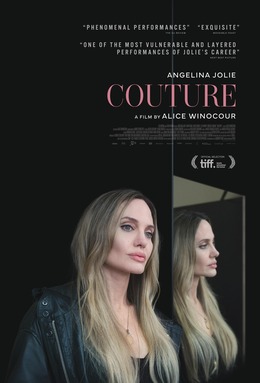
Angelina Jolie projects a dark silhouette of her autobiographical self for the film, Couture (2026), about a director whose next vampire film project is funded by the fashion house, Chanel.
The film is not promoted as a biographical film, but Jolie can be seen surfacing in the character, Maxine Walker, whose opening scenes are shot in the arrival terminal of a Paris airport as she receives an important call.
Home in America is continually connected with work in Paris through a series of important phone calls. One call in particular, from Maxine’s doctor, sets the tone for the film as she receives the news that her biopsy results suggest further testing is required as soon as possible.
That bad news quickly gets much worse.
Director Alice Winocour then begins to show the competing pressures on individual participants during Paris fashion week, including Maxine weighing the need to finish the film shoot and remain connected with her daughter in America.
Everything becomes all too traumatizing that Maxine splits apart like a dream sequence during a long night of nightmares, even with those phantom guest appearances of people your subconscious puts together, during the deepest darkest sleeps, who may or may not be your daughters.
The storyline includes the introduction of a new fashion model from Africa, Ada, played by Anyier Anei. The camera follows Ada about as she is introduced to the modelling agency and the models with whom she must share a Paris apartment.
The experienced models introduce Ada to the main motivation of earning lots of money and being able to travel for work to other parts of the world. The young and inexperienced Ada must learn quickly to survive.
The camera following Ada allows Maxine a few moments behind the scenes to process the shocking news of her breast cancer diagnosis and to figure out how she will be able to complete her film production work.
More time is needed so the stream of the subconscious also introduces a seamstress for Chanel, Christine, played by Garance Marillier, and a make-up artist, Angele, played by Ella Rumpf.
Winocour shows how all the participants are artists who make important contributions to the many moving parts of fashion week. Sub-plots are created that disappear into the unseen background, which generate further time for the life and death journey of the main protagonist.
Christine has great skill in preparing the center piece dress that opens the show, while Angela has another ambition of becoming a writer.
Maxine eventually reenters the narrative as her subconscious goes through the realization of the truth of her medical condition. She becomes so distracted that her colleagues begin to question her dedication to the film project.
Jolie makes a further autobiographical scene sequence by referencing her free love era, when she disclosed to a magazine interviewer that she enjoyed wild uninhibited hotel room sex, when Maxine bluntly invites her cinematographer, Anton, to come back to her hotel room for sex.
Anton, played by Louis Garrel, takes Maxine up on her invitation, after first convincing himself that the offer from the international sex symbol is real. Anton draws closer to Maxine emotionally through the sharing of intimate partner moments, despite being work colleagues.
Maxine, as filmmaker, is also a reference to Jolie, who has received critical acclaim as a director. Maxine is known for directing vampire/horror films, while Jolie is known for creating foreign war films depicting the damage the violence does to the fabric of people, family and society.
Maxine is fascinated by vampire blood, while Jolie is concerned with the collateral damage of war.
The parallel draws closer when Maxine explains that female vampire films are about the violence to which society subjects the female gender.
Everything disappears in the end as Maxine must abandon her film work in Paris and return to America to undergo chemotherapy and reconnect with her daughter. A departure terminal exists somewhere around here inside the trauma.
Winocour uses realism throughout the film to depict the artists as pleased with themselves in being part of the iconic fashion industry.
Perhaps Winocour purposely chose not to rely too heavily on biopic content from Jolie, because the film lacks that aesthetic surrealism that would have made more of a definitive statement of the film being a nightmarish dreamscape.
Without an element of that distorted lens, saying that the film depicts the nightmare that Jolie undergoes, as she realizes her dire health condition, becomes a bit of a reach, although that nightmare induced by a cancer scare could be one that seems so real that you wake up inside the dream only to realize you are still asleep.
Instead, though, in the absence of a more obvious dreamscape aesthetic, one should rather believe the script is not a biopic about Jolie, but instead a realist depiction of Maxine’s life and death journey, although, for the creation of the character, Jolie obviously draws from her personal experiences as a cancer survivor, film director, mother, actor, sex symbol and free-love spirit.
Couture is available to buy or rent in the Apple TV+ store.