
SFFB 2026


SWEENEY CHANGES ACTING MASKS FOR GRITTY BIOPIC
by PETER THOMAS BUSCH
The rising star in women’s boxing starts out with nothing in a small West Virginia town.
And Christy Martin almost ends up with nothing despite becoming a prominent female boxer.
Director David Michod creates a linear narrative for the title character with several twists and turns to show the road ahead is fraught with great peril.
The ‘another boxing film’ rings differently as the script occasionally finds social issues, such as gender equality and family violence, just as important as training.
Sydney Sweeney removes all the glamour from her screen character to perform more as a gym jock than a Hollywood starlit. The floppy hair cuts and baggy clothing of the era make everything fit a bit better.
Sweeney though creates just the right type of character who can endure the hours in the gym getting ready for that ‘next fight’ with a payday that will set everybody up for life.
The pickings are slim at first at $300 a fight. But those tough girl challenges bring professional attention to Christy as her raw talent may become even more special after a few weeks of professional training.

Ben Foster plays boxing trainer Jim Martin who initially wants nothing to do with a girl boxer (sound familiar) until he sees Christy’s knock out punch. Martin becomes more and more enthusiastic, but he cannot line up bigger fights for Christy.
Sweeney works through plenty of scenes of Christy training in the gym and running on the road, but the camera also follows Christy when she is not boxing, such as being content with spending time in a trailer after escaping her childhood home where her parents had begun to question her individuality.
The twist in the storyline occurs when Jim and Christy start connecting on an emotional level, as one might expect when two people spend so much time together. The rising sports star narrative then begins to move along side the ‘girl and boy kissing in a tree’ narrative, especially after the two love birds get married.
Christy transitions out of the trailer home, while the boxing continues on in front of bigger and bigger audiences.
A score wending through the scenes suggests something is up, other than boxing, well before the scene sequences begin to hint there is something wrong in love land. Of course, with the money from bigger boxing purses, comes recreational drugs, which induce the jealous husband to show more and more of his true self.
Christy can no longer just walk away, though, when the realization sets in that Jim might not be all that nice of a human being. Christy must stay because she only knows boxing, and only knows boxing through Jim.
Michod maintains an unglamorous movie aesthetic with all the main characters struggling with life while the leading players only having accumulated a modest house and a yellow sportscar for him, and a pink sportscar for her.
The first next big fight eventually does happen after Christy and Jim are introduced to sports promotor Don King. King wants to put Christy on the undercard of a Mike Tyson fight, and Christy aint gonna let nobody take the opportunity away from her.
Sweeney puts a lot into creating a character distinct from her performance in other recent movies as her Hollywood star rises. Christy has this toughness in the ring but then she also has a naïve vulnerable side that results in her beginning to suffer in her personal life.
The film is a bit of a throw back to the early nineties, with the scenes filled with low budget cars one step from the scrapyard, especially with the owners not minding too much about detailing the bodies and changing the engine oil.
The boxing genre film gradually turns in on itself with Christy using great technique to beat up opponents in the ring only to eventually get beat up at home.
ALASKAN FRONTIERSMAN PUTS DOWN CIA UPRISING
by PETER THOMAS BUSCH
Jason Clarke and Haley Bennett get an encore nomination for their performances in the Apple TV+ Series, The Last Frontier (Series 2025).
Clarke is in the lead role as an Alaskan Sheriff who unexpectedly becomes in charge of the capture of missing high risk prisoners after a prison transport plane goes down over a remote wilderness area.
The prisoners that survive the crash know enough not to want to go back to prison, and eventually, set out a path from the crash scene. Unfortunately, the number of casualties begin to mount as the survivors prove to be ruthless killers who take hostages in a desperate attempt to survive the wilderness and evade capture.
The desperateness of the prisoners hints of something else going on, especially when one heavily restrained masked prisoner is able to free himself and walk away from the crash site.
Haley Bennett gets introduced early on as a CIA handler, although everyone else is left to wonder, over several episodes, why the CIA is becoming involved with a downed prison transport plane.
Creators Jon Bokenkamp and Richard D’Ovidio put twist and turns into the plot as certain questions get answered while certain other question do not.
One interesting dynamic is that Frank is a former big city cop who stands out among the first responders in a small town. A similar dynamic occurs when the CIA begin to intermingle with Frank and local law enforcement.
In the end, or at least as the story progresses, the Alaskan community quickly tools up to address the risk to their neighborhoods and to their way of life that they worked so hard to establish in a sleepy, back water wilderness.
Sidney gradually becomes more involved in the narrative after being sent up from Langley to the crash site in Alaska. Frank lets Sidney ride along, but Frank soon has his suspicions confirmed when he discovers that the CIA is more deeply involved.
The CIA plot gets more complicated in parallel with how the town survives such an intrusion of criminality. And then someone trots out that old spy genre cliché of a stolen database.
Dominic Cooper is the CIA asset, Levi, who not only escapes from the crash site but seems to have been exceptional trained in the art of deception once inserted in extreme conditions.
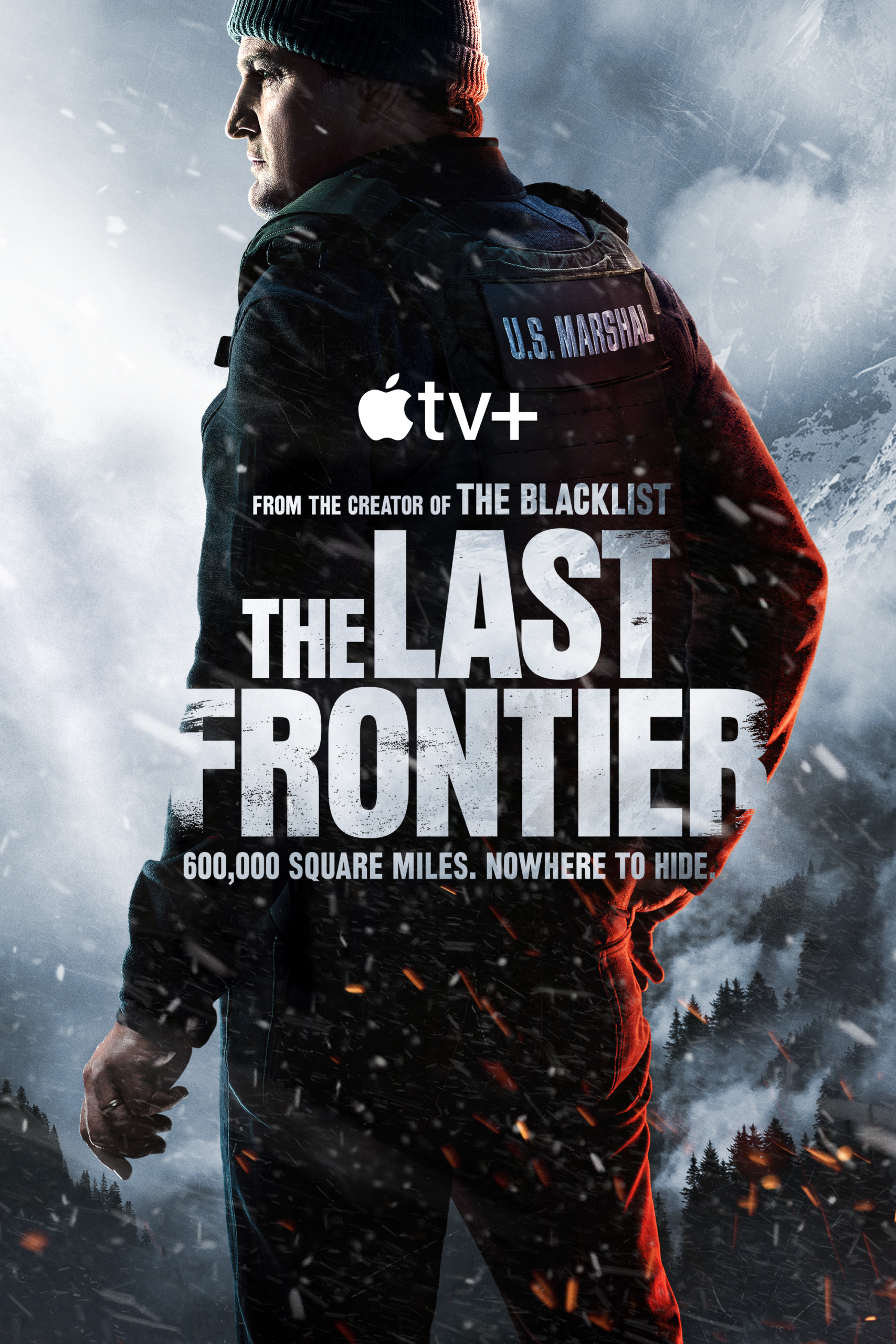
Frank has a whole lot of trouble at home. And Sidney and Levi have a past that keeps the camera rolling over 10 episodes. The season finale is currently streaming.
Just when everything gets sorted out, more characters are introduced, first individual prisoners on the loose who all appear to be sociopathic killers, and then certain high valued prisoners get captured, which leads to Frank’s greater curiosity, or if he is lucky, some actual leads into what is really going on.
Clarke builds an interesting character worth following right from the start. The director lets that story line develop, while holding back on Sydney until just the right time. Bennett eventually gets to perform a bit more dynamically, and a more three dimensional character is revealed.
CHILDREN IN SCHOOL BUS, WIND, FIRE AND HUMANITY
by PETER THOMAS BUSCH
The wind driven wildfires along the Camp Creek Road set the backdrop for the deadliest fire in California history.
The wind also drives a director and actor together to tell the story of how 22 elementary school children survived the natural disaster.
Director Paul Greengrass uses close cropped camera angles that incrementally piece together a portrait of school bus driver Kevin McKay.
Matthew McConaughey plays Kevin as a guy trying hard but who ultimately cannot get a break during a day with multiple challenges. Kevin has limited range and, as a result, must continually trade off one challenge for the other challenge until nothing gets done properly.
America Ferrara plays a supporting role as the school teacher, Mary Ludwig, in charge of getting the 22 children to safety.
Kevin is kind of pieced together as a non-starter, eventhough he tries his best and knows how to make tough choices. But the life that has been given Kevin just will not work out right for him.
The character’s backstory creates an unhappy context with his father having died four months earlier, and Kevin having moved back home to take care of his widow mother, only to have to then deal with putting down his cancer riddled dog. Kevin also has a personality clash with his teenage son, who would rather be living somewhere else than going to school.
To make matters worse, the new job driving a school bus doesn’t offer enough work to make everything worthwhile by paying the bills.
In this way, the director begins to explain the background of contemporary Americana in the portrayal of how Americans confront, anywhere any day, a mass casualty event.
The narrative continually intertwines, tighter and tighter, the story of the wildfire with the story of the school bus driver and the children in the school bus.
Greengrass creates an interesting natural aesthetic of the wildfire, with the fierce winds and shrapnel from the burning trees hitting the windshield of the bus as Kevin drives through the fire engulfing either side of the roadway.
The atmosphere and tone of the film become increasingly intense as the fire spreads from a two firetruck grass fire to a town fire requiring an evacuation order.
The use of a handheld camera adds to the tone, with the camera purposefully shaking the scenes and moving about unevenly.
If you think this is chaos, just wait for Kevin’s story, whose simple job driving school kids becomes a monumental challenge for him, having to sort out a lot of unregulated emotions that eventually merge with the story of the fire.
McConaughey builds Kevin into the personification of chaos, who eventually feels so much emotional pressure that he has an internal alarm going off inside him – which he tries to vent by lifting his arm up in the air and signaling for all the troops to rally around him.
McConaughey has everyone believing that his character will fall apart entirely and leave his other-worldly responsibilities to take care of his own family.
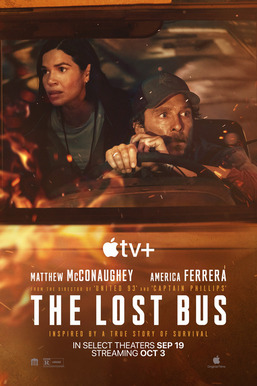
Then Kevin meets Mary, but the reversal scenes only lead to greater and greater chaos.
McConaughey then entirely plunges into his character who must take on the burden of being responsible for the lives of the children as the wildfire uncontrollably spreads even closer.
The fire chief’s evacuation notice has caused 15 miles of traffic gridlock. And so, Kevin’s chance to be a hero driving the children to safety has built in obstacles. McConaughey acts through several layers of emotions of a good person with many barriers scrambling to survive in a disaster zone.
Kevin does rise to the occasion, heroically.
The tension in the film is maintained by making the outcome always uncertain, while the camera gradually focuses on the story of how individuals can go through extraordinary transformations to survive tremendous adversity.
HEROIC CHARACTER TRANSFORMS INTO COMPLICATED SELF REFLECTIVE DRAMATIC ROLE AS SPORTS ICON
by PETER THOMAS BUSCH
The biggest actor in Hollywood has to be Dwayne Johnson weighing in at 6 ft 3 in (6 ft 5 in) and 255 pounds as professional wrestler Mark Kerr.
Johnson stars in the biopic The Smashing Machine (2025) about the origin of MMA or UFC or the start of wrestlers fighting boxers who also fight jiu jitsu artists, and then every discipline gets all mixed up into a new sport.
Director Benny Safdie encapsulates plenty of fight scenes into the storyboard, at least those 20 seconds or so of a victory in the ring, to drive the narrative forward.
And then Safdie uses Kerr’s relationship with Dawn to drive a second narrative in the background. Emily Blunt costars as Kerr’s love interest, Dawn Staples. The camera brings the love relationship closer and closer to the main narrative as the plot reaches the reversal scenes.
Blunt creates a complicated character that lacks emotional control and self awareness. Dawn enters a relationship with Kerr supporting his passion for professional wrestling, but who then finds something lacking in the connection.
The training sequences are kept to a minimum. And the pace of the film is slowed down for intimate moments at home with Dawn trying to contribute to Mark’s sports career as much as possible, such as by making protein smoothies and helping out during a pre-training stretching session.
Blunt does show Dawn as wanting a bit more attention, though, which leads to emotional chaos as those involved try to sort out priorities.
The story is filmed like a vlog giving each scene that self made documentary grittiness as Johnson moves from the locker room to the ring to the living room as if his best friend is following him around on set with a home movie camera.
A jazz score slows down the narrative and blurs the reality of a fighter preparing for the next match. These introspective moments depict Kerr struggling with the physical pain and a simple life that is getting more complicated with the emotional involvement of other people. And then popular songs pick up the pace on the way to another wrestling match.
The singular focus of Mark on his professional sports career causes Dawn to want more. Everything gets even more confused for both of them when Mark becomes addicted to the pain medication he uses to recover from the brutally violent clashes in the ring with other equally determined fighters.
The nickel and dime professional wrestling circuit quickly transitions to the bigger paydays of Mixed Martial Arts, at the same time the love interest creeps toward a do or die proposition.
Johnson creates a three dimensional character that drives the entire film while Blunt interacts in a supporting role just enough to bring that complicated character out. Dawn is there for Mark but the two characters together often make for intimate scenes of emotional trauma, when the camera slows down and everything focusses on the dialogue.
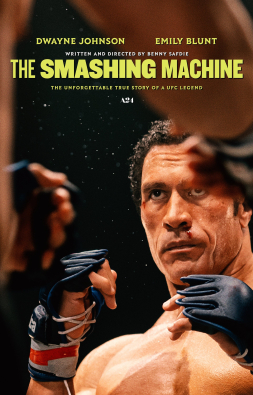
Kerr is portrayed as a soft spoken singularly focusses professional athlete, still struggling to attain the pinnacle of success he so desires. But the gentle giant’s ability to sweet talk his way through certain moral dilemmas hints at someone else hiding inside who randomly comes to the fore when he does not get his way.
There is enough of a love story there though to keep everything interesting until the end credits. You wait for the next fight scenes until you start wanting to know what the next stage of the love relationship is.
In this way, the plot incrementally spins inside and out.
Johnson wears a partial facial prosthetic that masks his regular heroic screen character while he has also developed this softer spoken more vulnerable persona, in a dramatic role. The actor suppresses the vitriol and bravado filled character, such as the frantic military veteran running security in Skyscraper (2018) or the whimsical tour boat captain in the Jungle Cruise (2021).
Blunt crushes the character in portraying Dawn as having a silent, inner complication, while presenting outwardly as a shallow persona who means well but just cannot keep focussed on attaining the best results from the most important moments in life with Mark.
In all fairness to Dawn, Mark is not the most impassioned lover, and he also cannot regulate his emotions on the days when love enters his thoughts.
ENCORE
GANG OF CHARACTERS CAST FOR NEW YORK STREET STORY
by PETER THOMAS BUSCH
The American Dream always had the supplementary list of tragic failures and deadly misfortunes.
Director Darren Aronofsky continues with his series of psychological realism films with a story about a teenage phenom, baseball player whose promising career suddenly ends on the eve of the professional draft.
The trauma from the life changing accident recurs to knock the hero down over and over again, through the life of Henry “Hank” Thompson, after he moves from California to New York City.
Austin Butler finds rhythm and pace acting in the leading role as the bartender haunted by the missed opportunity at greatness. Zoe Kravitz is cast well as Yvonne, Hank’s girlfriend.
Aronofsky does well in casting several character roles, with Liev Schreiber playing a gangster hiding out as an Orthodox Jew, and Matt Smith as Hank’s neighbour, a London punk rocker working the New York clubs controlled by the Russian mob.
The narrative gradually builds anticipation with the camera following Butler around the New York City neighbourhood set in the 1990s.
The prop department rolled out all the Big 4 automaker vehicles from the decade that have not yet found an end in the scrapyard. And the sets are primarily the inside of the unrenovated outdated tenements or the one dimly lit bar and pool table.
Butler incrementally builds his character’s personality as that good natured All-American sports hero who feels bad for those around him who have been negatively impacted by the mistakes he has made.
Hank seems to be succeeding again with the responsibilities of a barkeep. And the well adjusted Yvonne is happy, and makes Hank happy when they are together.
Aronofsky, though, puts trouble in Hank’s way.
The director in The Whale (2022), has Brendan Fraser playing an obese father trying to reconnect with his daughter. In Mother! (2017) Jennifer Lawrence plays a pregnant mother whose uninvited house guests become more and more suspicious. And in Black Swan (2010), Natalie Portman plays a dancer trying to survive the fierce competition of the ballet.
Butler must put his character’s value system to the muster as the narrative leads Hank into one misfortune after another, as a type of innocent bystander continually reminded of a guilty past.
Butler and Kravitz can only compel the narrative so far though, before the other unique characters begin to drive the interest in the plot and Aronofsky begins to layer dark humor into the crime thriller.
The second unit camera takes the characters to different parts of New York City not usually captured in films, such as the car lanes on the Brooklyn Bridge, and the empty spaces of Flushing Meadows and Coney Island during the off seasons.
Good editing drives everything together, such as the characters and the aesthetics of 1990 New York, and a suspenseful storyline.


IN REVIEW
DE NIRO FLOURISHES IN FRONT OF CREATIVE CAMERA
By PETER THOMAS BUSCH
Frank Costello and Vito Genovese grew up together and learned to become mobsters together on the streets of New York City.
But there came a time in the Luciano crime family when the two Italian Americans challenged each other’s leadership, Vito Genovese not being content with what his share had become.
Director Barry Levinson creates a stylized portrait of that period of tremendous uncertainty in the life of the American mobsters.

Levinson does not turn the narrative into a retrospective, and instead, focusses the camera on the mobs real-life reversal scenes. The director then slices in the backstory with the use of dramatized black and white photos, original network reels playing on the TV and a lot of nostalgia for New York City.
Robert De Niro performs a wraparound as Frank Costello, transitioning scenes with a voiceover and the occasional scenes talking directly into the camera.
De Niro transitions from an elderly Costello to a younger but still older mobster and also, if you happened to miss the marketing campaign, the doppelganger protagonist, Vito Genovese.
The Vito character sketch hides the De Niro actor, a bit more than the Frank character, with tinted eyeglasses and a stylized hat. The hair and make-up department do the rest of the work by personalizing the different characters’ noses and jawlines.
De Niro though does most of the character development work by creating two distinct characters. Frank, having more of the mob under his control, prevails over a lot of the street chaos with a calmer demeanor, and a more rational approach to the situation, even after barely surviving an assassination attempt.
Vito is quirkier, showing more of the irrational temperamental personality and impulsiveness more often shown by gangsters who are criminals through and through.
Levinson distinguishes the two worlds, that each character has created for himself independent of the other, by casting talented supporting characters for each leading character.
Debra Messing as Bobbie Costello develops the character with that born and raised New York City accent, who is not so dreamy eyed over her marriage partner but definitely loyal, determined and in love.
Kathrine Narducci is more of an Italian-American New Yorker as Anna Genovese, whose classic spirit comes out as the mutually convenient relationship begins to fall apart, giving her every right to get upset.
Levinson moves the 2 hr 3 m runtime with this character development. The camera follows the two mobsters but then pieces together more of their characters by showing the personalities behind the people closest to them.
The brutalized killings of the gangster genre, popularized by the director Martin Scorsese mob films, are noticeably absent. The scenes instead are compelled forward by the talent in front of the camera and an interesting enough story that is not complicated but maintains a consistent level of interest nevertheless.
Composer David Fleming creates a score that matches many scenes, frequently adding a tension to the already intense dialogue. The score throughout the film replaces the sound of guns exchanging fire and long knives clashing.
A creative flourishing occurs behind the camera as well with Levinson using a variety of camera angles and inventive scene framing that incrementally builds tone and atmosphere as the storyboards begin to pile up.
Levinson keeps the camera out of the backstory where a lot of the true crime activity of these biographical characters occurs – and instead the director creates an intensity by juxtaposing the competing worlds of the characters as Vito strategizes for absolute control of the New York City streets.
The props are noticeably from this particular era of gangsters. And the classic antique cars being driven in the streets during transition scenes establishes a stimulating aesthetic.
What kind of becomes left behind in the genre are the complicated three dimensional narratives that compels a gangster film back and forth from the crime world into the personal lives of the individuals, and then between competing crime families, until all hell breaks loose in gunfire and madness.
Levinson, instead of following the tried and true template, sets up a uniquely personal style within the gangster genre right next to, but apart from, a Scorsese mob film or a Francis Ford Coppola mafia epic.