
JANE
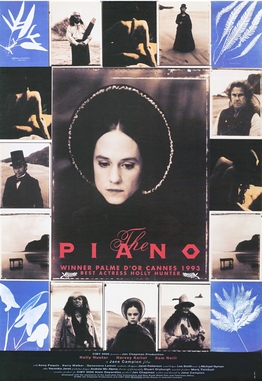
VOICES OF DESIRE FIND VISUAL IMPRINTS ON FILMS ABOUT POWER IMBALANCES
by PETER THOMAS BUSCH
Well, you see, there’s this piano that the director wants to use as the narrative device, but she refuses to use movie magic to get the piano off-loaded on a remote beach and transported along a bushwack trail to a village in the Mauri territory of New Zealand.
Holly Hunter, Anne Pequin, Sam Neill and Harvey Keitel get cast to unravel the metaphor of female disempowerment, colonialism and indigenous rights with the piano stuck in the beach sand, left subject to the mercy of the saltwater tide.
If nothing else, the journey forward will be a process of self discovery accented with an epic sweep of landscapes and secret thoughts.
In The Piano (1993) director Jane Campion lends her distinct feminine interpretation to an ever present human story of struggle and survival by moving the heroine from failure to success.
Campion creates tension from the onset by making everyone look through a black screen and then turns the camera to reveal fingers covering the face of the protagonist.
The voice over leaves no doubt that the film’s point of view is that of a woman who expresses herself through music – partly because she has become mute. Hunter like Campion must tell her character’s story without talking.
Screens of all sorts are used in subsequent film projects as a way of the director being transparent about using the camera to give voice to the silent internal monologue that runs deep inside many a storyteller.
The trusses of a city bridge symbolize the inner fear of a potential homicide victim in the film, In the Cut (2003). The open door frame becomes an opportunity for freedom for a young lady trapped in the era’s courtship rituals, in A Portrait of a Lady (1996). The railing in a hallway foreshadows the untold wishes of a sibling, in The Power of the Dog (2023).
Campion organizes the narrative of her films in such a away that she not only visualizes the opening and closing scenes, and every scene sequence in between, but she also weaves in symbols and metaphors of major social themes.
In this way, the camera creates tension that compels the story forward after the director has made her intensions as transparent as possible.
The only thing the omniscient director cannot do is speak the dialogue and act the parts. Campion uses the cast anthropologically by using the characters to illustrate the objective truths of the past and to convey meaning of an earlier era.
The social gender barriers, like the female dress and corset, are so elaborately confining to the body as to be like the piano holding the music inside.
Holly Hunter creates a character that personifies not only the contrasting ideas of feminine beauty and sexual powerlessness, but also the colonization of previously unknown indigenous worlds.
In A Portrait of a Lady (1996) Campion explores female conformity to the rituals of courtship. Nicole Kidman plays Isabel Archor, courted by three eligible suitors as Campion fills the cast with Hollywood’s present and future leading actors.
The female protagonist ought to have the power in the relationship, but Campion shows that the male suitors are actually masked antagonists who have all the power, and ultimately disempower a young woman whichever way she chooses or does not choose.
In the Cut (2003) Meg Ryan plays a New York City English professor who should have all the personal power she needs, but she is continually put in a position where she loses power, and ultimately survives each day with an increasing power deficit.
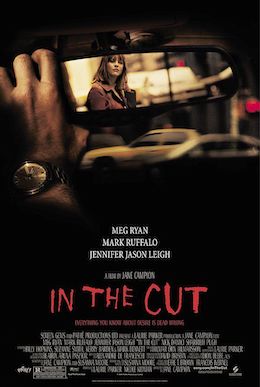
Mark Ruffalo plays a detective investigating a serial killer who likes to decapitate his victims. Frannie is in the wrong bar at the wrong time, but her inner thoughts keep secret a passion more compelling than the current truth.
The detective and the serial killer follow Frannie around the city until the next victim surfaces in her apartment.
Frannie wants to be free and left alone, but humanity’s innate sexual desire keeps pulling her back into the gender power imbalance. The silent human motivator of sexual desire finds expression in several different Campion films, but the need for fantasy and pleasure is all the more apparent next to several gruesome discoveries.
Campion frequently contrasts opposites, populating the scenes with differences and similarities.
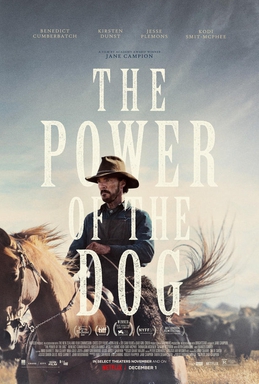
The cast and crew are a bit older, 20 years later, including the director, with the need for pleasure and other secret desires internalized in The Power of the Dog (2023).
The characters nonetheless exhibit signs of the innate drives.
Benedict Cumberbatch and Jesse Plemons are cast as two brothers who co-own a cattle ranch and come to terms with their relationship. Kirsten Dunst and Kodi Smit-McPhee co-star as the not so innocent third parties.
Campion uses her signature story telling device of incremental character development through the visualization of inner thoughts and through intimate dialogue to explore the importance of relationships and family in the absence of either, or.
The desire to find meaning in family and relationships is shown to be interlinked with fleeting escapes into fantasy.
In Montana cattle country, the things people share hold value in how well relationships form, including the picturesque landscape.
Phil provides for his ranch hands, and shares knowledge to maintain the bond of hard working ranchers in a rugged environment. This bond of family includes a trust between individuals that is betrayed only with dire consequences.
Brother George leaves the intimacy of kinship to form a new relationship with Rose. Phil then forms a bond with Peter, with whom he develops trust by sharing knowledge.
A rope Phil is making with rawhide becomes an important object lesson, as the strips of hide are tightly woven together.
The relationships being affected by the sharing of the rope is a similar dynamic to the music made with the piano. Campion then shifts everything around, switching intentions and emotive triggers so that the only certainty is the impending uncertainty.
Campion uses the landscapes as the one constant, around which, and in reaction to, individuals and communities are shaped and formed.
Jane Campion, by Kathleen McHugh, Chicago, University of Illinois Press, 2007.
Jane Campion, Edited by Virgina Wright Wexman, Jackson, University Press of Mississippi, 1999.