
AKIRA KUROSAWA
ICONIC MOVIES
SAMURAI FILMS PROVIDE BLUEPRINT FOR SPACE OPERA
by PETER THOMAS BUSCH
T
he samurai became the subject of Japanese cinematography projects all the rage in Asia at the same time Hollywood was producing western films about cowboys featuring America’s greatest movie stars.
The Jidaigeki Period action films were set to take place during the 1603-1868 epoch. And Japanese filmmakers relied on an established set of cinematic conventions to tell the stories of the samurai.
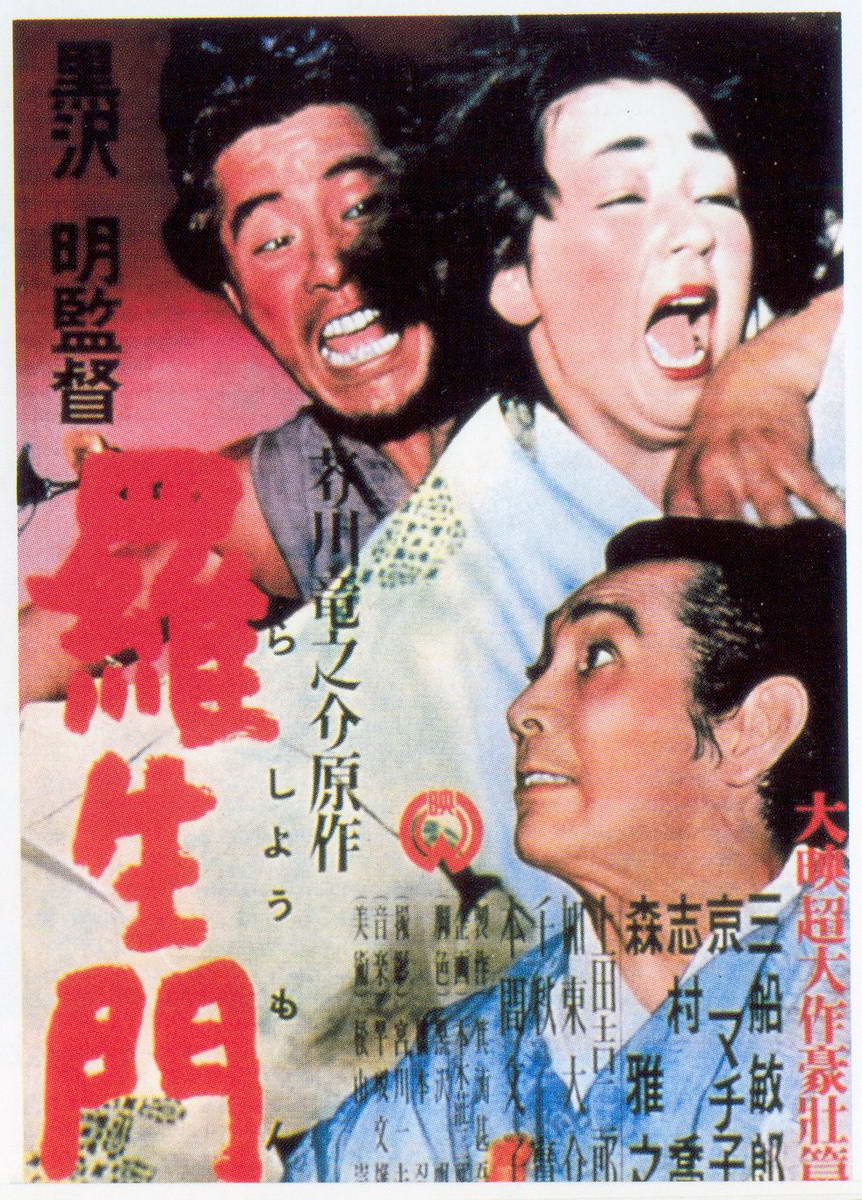
Akira Kurosawa made a series of films that were popular in Japan as well as critically acclaimed and influential in global filmmaking including in Europe and in Hollywood film production. Kurosawa began his directing career by winning the Golden Lion at the Venice Film festival for the film, Rashomon (1952).
Kurosawa, like many filmmakers, would use the same film crew and actors in subsequent films as a way of quality control and predicting future outcomes of the final film cut. Kurosawa, for example, cast Toshiro Mifune in the lead samurai role in several films, ultimately collaborating with the actor 15 times throughout his career.
Kurosawa would also frequently use cinematographer Azakaza Nakai as part of his film crew, and to create the movie magic that would entrench his reputation among film scholars, including the emerging academically trained class of independent filmmakers in Hollywood.
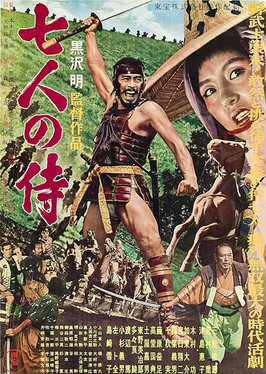
The film, Seven Samurai (1954) is set in a village beset each annual harvest by bandits who steel the community’s rice stocks. The village elders finally set about to end the madness by retaining a group of Samurai to bring an end to the extortion game.
The samurai turn the village into an encampment and teach the villagers how to defend themselves. If this plot sounds familiar, it should because Hollywood adapted the film into the Magnificent Seven (1960), starring Yule Brenner, Steve McQueen, Charles Bronson, James Coburn and Eli Wallach.
The Hollywood adaptation was reimagined in 2016, starring Denzel Washington, Chris Pratt and Ethan Hawke. Peter Sarsgaard plays the villain.
Up next for Hollywood was the Kurosawa film, The Hidden Fortress (1958). The story paints the life of Japanese Princess Yuki who must hide from a tyrannical power until she can escape with the help of a master samurai, played by Toshiro Mifune. The film features two idiots continually causing problems for the samurai and the princess.
Kurosawa had studied the plays of William Shakespeare, adapting Macbeth and King Lear into feature films. The idiots continually dropping the message are played by Minoru Chiaki and Kamatari Fujiwara.
Kurosawa does a take on the King’s spies, Rosencrantz and Guildenstern, who carry a letter of their own execution, believing the message to be about the assassination of Prince Hamlet, in Shakespeare’s play, Hamlet.
Film maker George Lucas identifies The Hidden Fortress and the samurai films of Kurosawa as influential to his making of the first Star Wars films, especially the first film in the trilogy, Star Wars: A New Hope. Lucas remakes the idiot characters of The Hidden Fortress into the artificial intelligence units, R2-D2 and C-3PO.
Lucas also uses the plot of a princess escaping the dark forces of the universe with the help of a master Jedi. R2-D2 carries an important message from the Princess during the film.
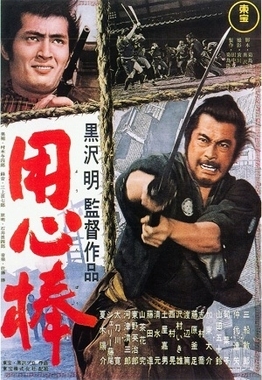
Kurosawa’s most influential film determined the future of the Hollywood western as well as the cop dramas of the 1970s. Yojimbo (1961), which translates as ‘bodyguard’ is a film about a samurai, played by Toshiro Mifune, who wonders into a village ripped apart by two rival gangs.
The film’s narrative is a critique of capitalism and the corruption of state authority. The samurai plays one gang against the other gang to earn a living, while saving several women from bondage, and ruining the competing business, in the result.
Kurosawa becomes one of the first filmmakers to master the syncing of the movie soundtrack with what the images are doing on the screen.
Kurosawa also infuses humour into the violence occurring on screen, with some film critiques suggesting that the samurai film is a comedy. A gang fight scene is shot with humour by having the rival villains timid and trembling at the thought of the conflict in the middle of main street. The blood and violence that would be shown in a Hollywood western becomes assumed by the audience.
Kurosawa also creates dimensional scenes by using action and sets to frame the narrative unfolding deeper into the focus of the lens. The scene might involve characters talking inside a building, but the camera is really focused on the action seen through the windows that occurs on the street outside.
Depth is also created by characters presented out of focus in the foreground while other characters are in focus talking in the background. One character is filmed hiding in a cluster of daisies that creates an added dimension to the scene that would otherwise appear flat on screen.
Yojimbo is more heavily adapted than any other Kurosawa film by Italian film maker Sergio Leone in the film, Fist Full of Dollars (1964). Fist Full of Dollars is part of the Spaghetti western films by European directors filmed in Italy and Spain.
Leone adapts the plot as well as parts of the script and filming technique such as an unusual attention to detail in close ups showing the beads of sweat on the face of the cowboys.
Kurosawa used a similar technique to detail the rain running down the faces of the samurai, and also close-up shots of the wind blowing about the dust and leaves in a room.
Leone also syncs the sound tract with the action occurring on the screen, and becomes well known for mastering this technique.
Filmmakers Ingmar Bergman, Steven Spielberg and JJ Abrams also cite Kurosawa as an important influence on their film techniques.