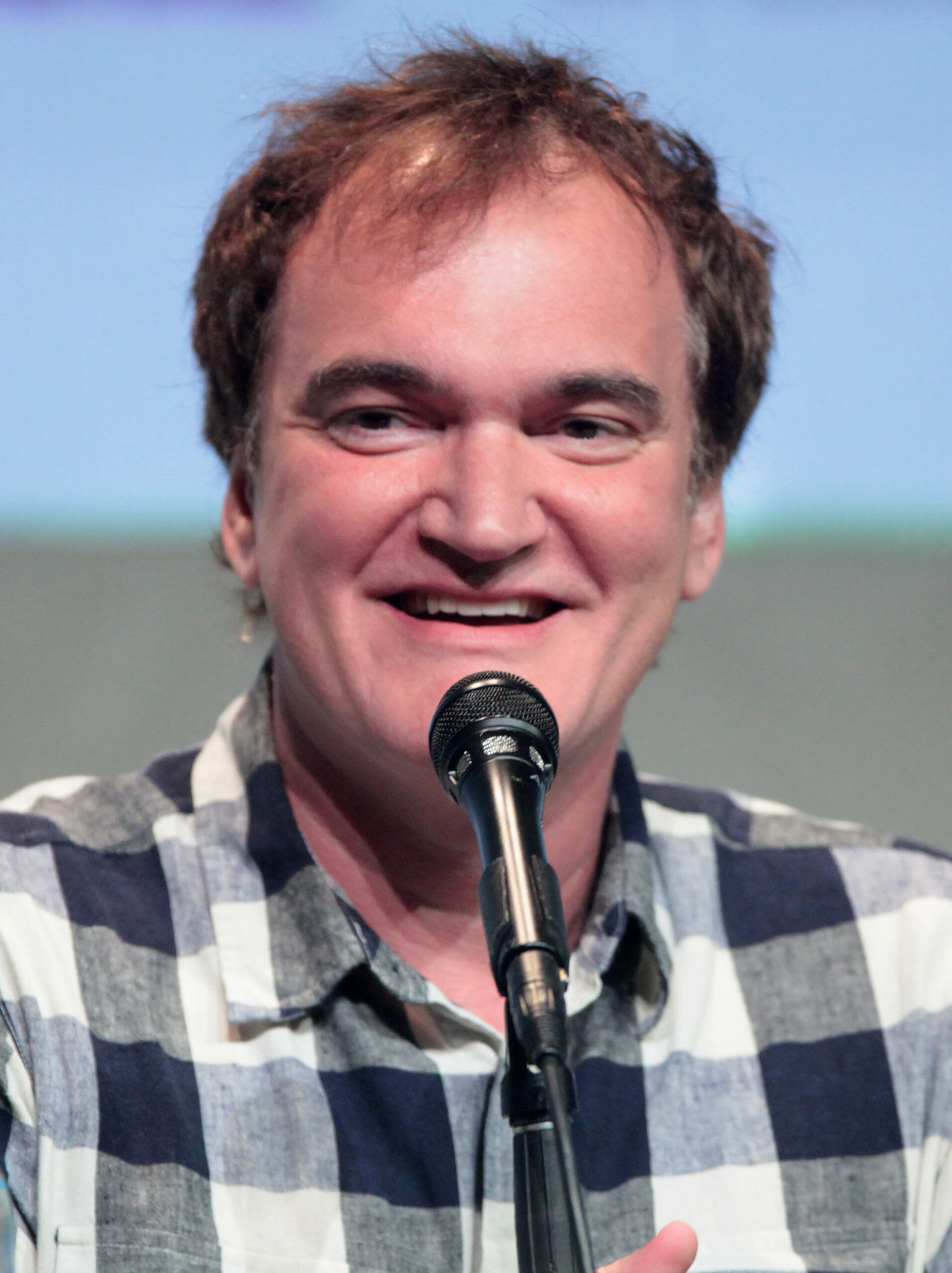
QUENTIN
GREAT NEW ORIGINAL VOICE FOR A GENERATION OF CINEPHILES
By PETER THOMAS BUSCH
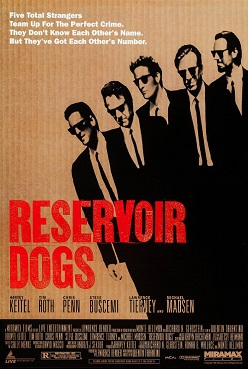
The real experiment with time and narrative begins, perhaps because of the budget limitations that affected the production, with Reservoir Dogs (1992) becoming the surprise smash hit that set up Quentin Tarantino for a career in filmmaking.
The main scene sequences take place in a warehouse, while the story of a major heist filters in through the windows as everyone’s traumatized memory becomes part of the storyline in tiny time fragments.
Tarantino had been preparing for his role as a generational voice by developing scripts that would be produced by other directors, such as True Romance (1993) directed by Tony Scott, and Natural Born Killers (1994) directed by Oliver Stone.
Scott was in the process of completing a series of action films on his way to mastering the genre. And Stone was in the process of creating a trench of films redefining Americana.
The scripts read like clippets gathered from inside the South Bay video store where the screenwriter had been working his imagination in Los Angeles while perusing the store’s inventory while finding and to returning rental videos to and from the shelves on all sides of the retail space.
Outside the fantasy world Hollywood film production companies had been creating, destined for replay on VHS tapes, the real world cultural fabric was fragmenting and flowing back into the ocean.
Scott was showing America how well things blew up, while Stone was bringing into the light of day the points of contention in American history, such as the American involvement in Vietnam, the assassination of a United States President, the new generational sound of The doors exported from Los Angeles to the rest of the world, and the backyard violence created by Americans trying to survive in the competitive market environment of capitalism.
During the hours rehearsing his characters’ lines while wringing in the customer rentals, Tarantino came up with a snappy dialogue style for the scripts, to be spoken by sharp suited pop culture characters pulling streeters, as film was influenced less and less by the cocktail generation.
The video store clerk received $30,00 for the script to True Romance. And then he obtained a $1.3 million budget for Reservoir Dogs. Pulp Fiction was produced on a budget of $8 million.
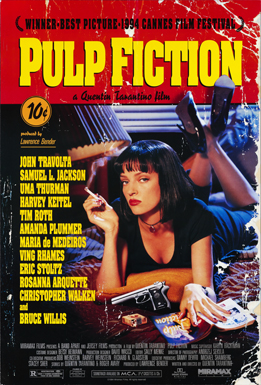
Pulp Fiction (1994) quickly influenced the collective consciousness, not only for an audience but for a new generation of filmmakers.
Guns and the random killings for which Los Angeles had become known around the world were just the surface of a layered, fragmented storytelling that hinted of life unfolding catastrophically for different characters simultaneously, but in different spaces during realtime.
The prospect of the random street violence being inevitable was replicated by Tarantino to create suspense.
The films were also referential to other films at least in individual scene sequences, if not to entire films. The shadows from classic Hollywood were fascinating to watch, as just one part of a subtle shock and awe technique.
Just listening to the dialogue alone would draw the audience into a sensory stimulating and thought provoking context.
Tarantino also infused a self-referential element by often not hiding the reality that the images had been produced as entertainment. The filmmaker went to acting class, wrote the scripts, cast himself in cameos and small parts in his own films, while all along directing characters he created in front of a camera he obviously controls.
The films were the creation of an overqualified retail clerk with a lot of down time on his hands to develop his imagination.
One way Tarantino shows that the director is in complete control is by fragmenting the storyline and then piecing the fragments back together again, within a complete narrative, only to occasionally have another go at spontaneous, simultaneous fragmentation.
The world outside seems to absent meaning other than generating from time to time the rhythm of a good story.
Pulp Fiction has four stories that only gradually make sense within a specific context, that inevitably merge into one.
A restaurant robbery by two love birds, played by Tim Roth and Amanda Plummer, provides a wraparound. The non-linear narrative also becomes intertwined with a drug deal between professionals and amateurs, including a phantom character reciting biblical scripture, played by Samuel L. Jackson. Another character, played by John Travolta, becomes involved in the first two stories, and then also a third story about dating Marsellus’ girlfriend.
A retro-static soundtrack drives the fragments forward, although separately: characters, scenes, storylines, and the director’s camera all get second chances in subsequent film sequences.
Marsellus, played by Ving Rhames, gets named dropped by other characters, but he quickly becomes the main protagonist influencing all the other characters around the different spaces, including a fourth story about fixing a boxing match that involves the screen character of Bruce Willis, as one of the boxers.
Tarantino creates suspense by making his camera more prominent than his leading protagonist, and the supporting characters usually in the back story, more interesting with extra details, in the foreground.
The audience becomes aware of Marsellus because he is such a prominent figure in the supporting characters’ consciousness. But Ving Rhames has screen time only ever so sparingly, within an ensemble cast of interestingly, quirky and spontaneously violent characters.
Tarantino also recasts actors in subsequent films, such as Samuel L. Jackson, Tim Roth, Uma Therman and Leonardo DiCaprio, which reenforces to his fans that someone else beside the protagonist is in control of the story, such as an omniscient storyteller.
The South Bay video store clerk has watched 4 films now, in one long shift and cannot remember which scenes fit with which of the four narratives. Instead of worrying about the editing conundrum, Tarantino makes one film from the best parts of four films, and then goes home for the night, a bit exhausted, but also quite content with his creation.
Tarantino frequently creates strong female characters often around which everything revolves at least for a few scenes. Uma Thurman plays Marsellus’ girlfriend, Mia, whom everyone respects because of her connection to Marsellus. But Uma creates a character that can stand on her own, and who might be more charismatic than the person everyone works for, especially when he’s not around to tower over everybody.
When Tarantino’s femme fatale character overdoses, chaos ensue because of Mia’s importance to the story and the repercussion her death would cause.
The prospect looms over the film that Marsellus may become furiously violent after having a bad business day on the streets of LA, since a couple of young kids tried to burn him in a drug deal, and then he almost lost his money in a robbery by two-bit losers, while at the same time, he gets double-crossed by the boxer in a match fixing scandal all in the span of a 2h 34m runtime.
Street life can be a bit terrifying to the uninitiated.
In Jackie Brown (1997) Tarantino casts Pam Grier as the leading protagonist of an airport heist. Tarantino creates three layers of a money laundering operation that drips with suspense by inferring that at some point in the story everyone will get ripped off. The director holds the suspense by delaying the outcome and non-disclosure of who, if anyone, will benefit from the scheme.
This story telling strategy is classic film noir. Noone really knows, other than the director, who has the real Maltese Falcon in The Maltese Falcon (1941), or why the Maltese Falcon is so sought after.
Grier plays Jackie Brown, an airplane stewardess, who initially gets duped into transporting cash on her flights. The Federal Bureau of Investigation entice Jackie to participate in a sting operation, and as a result, the story begins to revolve around Jackie and whether she will profit from the undercover work.
Grier stars, with Samuel L. Jackson, Bridget Fonda and Robert De Niro in supporting roles.
In The Hateful 8 (2015) the darkest days of the Wyoming winter provides the set of a bounty hunter returning to the town of Red Rock with his bounty, just after the Civil War when the slave trade comes to an end in America.
Samuel L. Jackson plays Major Marquis Warren personifying the free blacks who had fought for the Union Army against the Southern, slave owning Confederates.
Kurt Russell plays bounty hunter John Ruth, transporting most wanted, Daisy Domergue, played by Jennifer Jason Leigh. Ruth has the high ground, since the bounty is for kill or capture, and he chooses to capture his bounty and transport them back to town for their official hanging.
The film loosely follows the plotline of the classic Hollywood John Ford film Stagecoach (1939), with the stagecoach picking up passengers along the way and then stopping at a safe house as the winter storm approaches during the night.
The film hangs on the dialogue and the character development, and the potential violent outcomes of relationships between specific characters.
The video store clerk bit on a few hard kernels after helping himself to the store’s large bag of popcorn, with extra butter, while watching, over and over again, one of the classic Hollywood films of all time.
Instead of the landscape of Monument Valley and the threat of an Apache war party in the background used by Ford in Stagecoach, Tarantino uses a winter snowstorm and the conflicting interests of bounty hunters deadlocked overnight in lodgings.
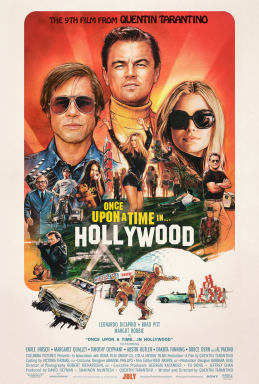
Once Upon a Time in Hollywood (2019) is a self-referential pop cultural spin on the film industry with Tarantino using his distinct voice to showcase the three classes of film artists surviving in Hollywood.
Margot Robbie plays Sharon Tate, who is at the top of stardom at the time of the story, just before her murder. Leonardo DiCaprio plays contract actor Rick Dalton, who may be John Wayne delaying the end of his career by taking roles Italian produced westerns. And Brad Pitt plays the hard working stunt double.
The film reflects the style adopted by Tarantino of repeatedly choosing to blend three genres: the film noir, the heist movie and the western, except now his fans get a more direct view of the story unfolding behind the camera.
Robbie creates that starlit infatuated by her own success. DiCaprio plays an antihero star barely surviving in Hollywood as his marque days in front of a camera are coming to an end. Pitt personifies the swashbuckling backstory of Hollywood, hard working and earning a living, and having a lot of fun in the process.
The films in the Tarantino oeuvre have a tinge of parody, without being entirely transparent about the reference. In this way, the video store clerk tips his director’s hat to his own backstory while creating refreshingly new storylines that define a generation.
No doubt that telling stories about America shifts from the dramatized documentary style of Oliver Stone to fictionalized interpretations of contemporary society that emphasize entertainment over informing the public.
A filmmaker does not have to invent the genre, just showcase the rules of the genre while producing a new film. The film series also influences other filmmakers, who themselves then become influential in their own right.
Tarantino was selfish and greedy, a lot like his characters, by wanting to control all aspects of the film, from screen writing to directing. In the end, a distinct cultural voice was created for a generation of cinephiles.
Quentin Tarantino: The Complete Unofficial Guide, by Dan Jolin, London, Greenfinch, 2024.